Pressure

Normal force per unit cross-sectional area

p=FApressure=normal forcecross-sectional area\begin{align*} p &= \frac{F}{A} \\ \text{pressure} &= \frac{\text{normal force}}{\text{cross-sectional area}} \end{align*}

Unit of pp = Pa\mathrm{Pa}

Pressure in a fluid produces a perpendicular force onto any surface

Hydrostatic pressure

Pressure in fluids

Δp=ρgΔhchange in pressure=density⋅gravitational acceleration⋅change in depth\begin{align*} \Delta p &= \rho g \Delta h \\ \text{change in pressure} &= \text{density} \cdot \text{gravitational acceleration} \cdot \text{change in depth} \end{align*}

Pressure at the same depth is the same regardless of the shape of the water column above
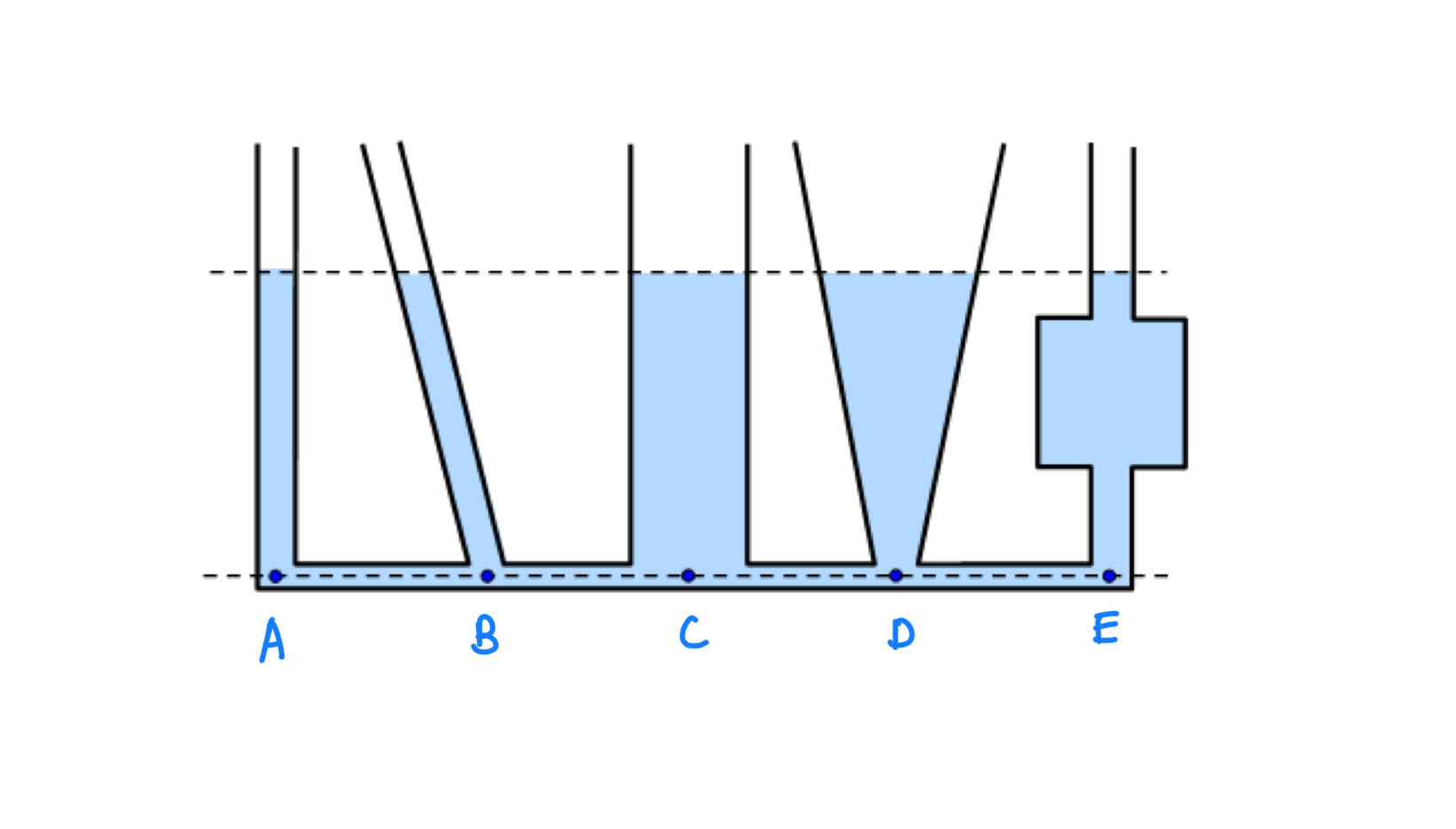
Hydrostatic pressure in containers of different shapes but the of same liquid level
Pressure at A, B, C, D and E are all the same


Derivation

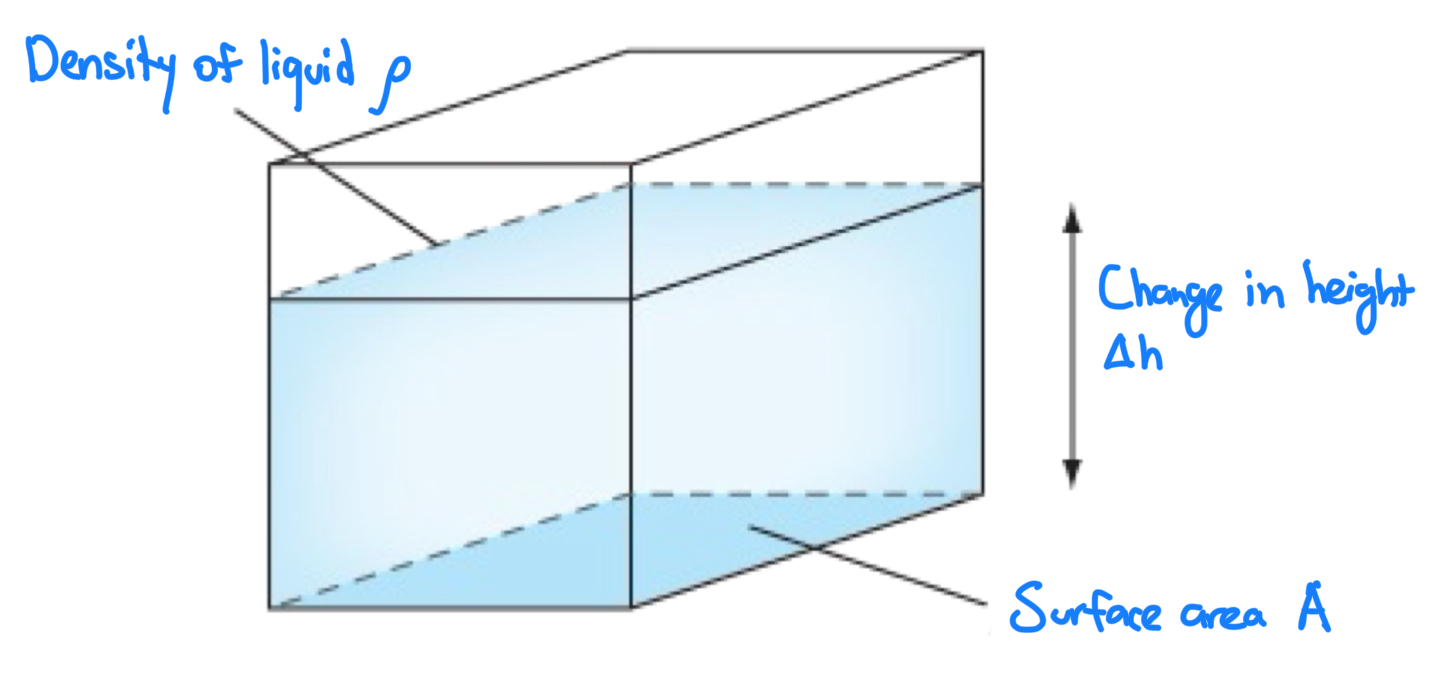
Diagram for defining variables for derivation of hydrostatic pressure

volume of liquid  V=AΔhmass of liquid  m=ρV=ρAΔhweight of liquid  F=mg=ρAΔhgchange in pressure  Δp=FA=ρAΔhgA=ρgΔh\begin{align*} \text{volume of liquid ~} V &= A \Delta h \\ \text{mass of liquid ~} m &= \rho V = \rho A \Delta h \\ \text{weight of liquid ~} F &= m g = \rho A \Delta h g \\ \text{change in pressure ~} \Delta p &= \frac{F}{A} \\ &= \frac{\rho A \Delta h g}{A} \\ &= \rho g \Delta h \\ \end{align*}